The Finals, Brian Cox | Sky Portrait Artist of the Year
Updated: Dec 4, 2025
So, the final is here, and if you've already watched the episode, you'd know that I am honoured to have been named the winner of this year's Portrait Artist of the Year competition! I've made a separate post about the commission piece I made of my housemate and best friend, Matt, which you can read here. Before getting into the thick of my portrait of Brian Cox, I wanted to talk a bit about making a monotype for the finals. Like my other posts, I've broken up my blog into the following sections: Making a Monotype, The Preparation, The Finals, The Final Artwork and Afterthoughts.

Making a Monotype
After the semis, I was asked whether I wanted to make a monotype for the finals. Without access to an etching press, creating paintings on aluminium had been my choice of medium in the competition; an adaptation and now an extension of my monotype practice. However, with the option to make a monotype, this opened an entirely new possibility for me. I was introducing the greatest layer of risk to the stage with the highest stakes. This was a moment to show people exactly how and what I do in its entirety, and even if it went horribly wrong, I could bring light to my medium.
I've previously written about how monoprinting is unpredictable and my considerations when making a monotype. Without going into crazy amounts of detail, things that can affect the printed outcome include: the pressure of the etching press, the dampness of the paper, the heat of the studio when painting, the use of solvents, the thickness of the painted ink, the time taken and the order of painting my plate.
Typically, printing presses remain stationary in print workshops and don't move for the foreseeable future. They are serious bits of kit, so they need specialist teams of people and equipment to move and transport. For the finals, we liaised with Ironbridge Fine Arts, fabricators of the Gunning Etching Press, which can be made with wheels. I have met master printmaker, Jenny Gunning, who actually takes her personal press around the country for demonstrations and workshops. Although I've never used this brand of press before, I felt assured that they were the best people to work with.
Going into the finals, there was another level of risk I needed to consider, including the following:
Using an etching press I've never used before. I would not be able to "dial" into the press and figure out the right amount of pressure I need for monoprinting.
The film set conditions. With the studio lights, the set in the heats and semis was noticeably hotter than my personal studio. This speeds up the drying time of my inks on my plate, which can affect how they transfer to paper
How will I dampen paper to print with? Normally, I soak paper on demand in the print workshop. I would not have access to a water bath at Battersea Arts Centre, so I would need to figure out an alternative.
Once I print my plate, how will I dry the paper to prevent cockling, whilst allowing me to work on top of it afterwards? Usually, I leave prints under boards to dry for a week.
How will I deal with having less time to paint my portrait? I need to give myself around an hour to set up and perform the physical printing. This will give me around 3 hours to paint my plate.
The colour of the monotype was also something I needed to consider on the day of the finals. A big difference here was that I didn't need to select an ink that looked good on aluminium. In fact, the mixed ink I used to paint Brian's portrait (a dark brown) was not appealing on the metal surface and would not have made an impactful painting on aluminium. But I knew that it would look different on paper.
Numerous factors could negatively impact my monotype, not to mention my physical/ mental state, the pressure of being filmed and the unknown of painting from life. I entered the finals knowing these risks, and the opportunity to show people what I do meant that it was all or nothing.
The Preparations
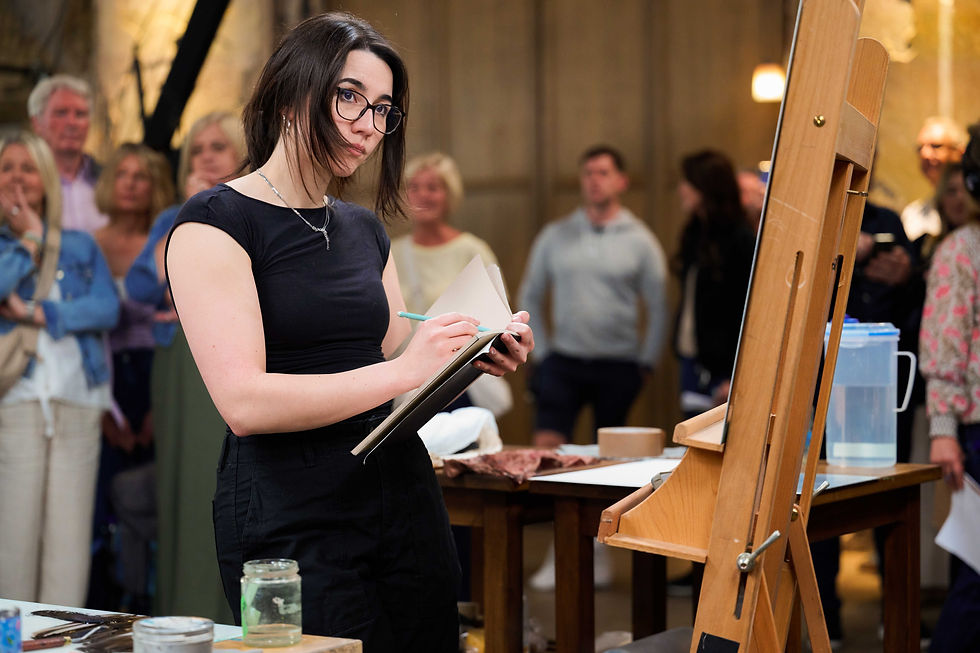
Alongside creating my portrait of Matt and filming, I spent the week between the semis and finals trying to troubleshoot the additional considerations I listed above.
The beauty of the printmaking community is how we come together to discuss and share processes. I went to two master printmakers at Thames-Side Print Studio, Ling and Nick, for advice. Ling talked me through creating damp packs of paper that I could make the day before the finals and transport with me to Battersea Art Centre - this would solve my issue with needing a water bath and soaking paper on demand. Nick then walked me through gum taping my monotypes to an upright board, allowing them to dry without cockling, while also allowing me to make some finishing touches on the final print. I trialled both of these new techniques across the three monotypes I made of Matt, so I felt comfortable on the day of the finals.
As I was attempting to make a monotype in the finals, I knew I had less time to paint my plate. I decided to give myself 3 hours to paint and to work on a smaller plate (60 x 80 cm) to accommodate this shorter time frame.
Leading up to the finals, I spent Friday afternoon/ evening, Saturday, and Sunday creating three monotypes of Matt. I worked my day job on Monday and then spent the evening at my studio applying finishing touches to my commission piece and making the damp pack. I got home just after 12 pm, before attempting to sleep at 1:30 am.
The Finals
The finals were here, and the morning was a blur of coffee, triple-checking equipment and reciting the steps of my process in my head. I was reunited with Katie and Lauren. With much fewer artists this round, it became very real how far we've all come. The impact this opportunity could have on my career meant everything to me, but I was already proud of myself for getting this far.

The Set and Brian Cox: When Katy, Lauren, and I walked into the main room for the final time, we were met with a theatrical set with jute drapes and an earthy orange velvet chair. To me, the set felt masculine, dramatic and heavy... which made sense when Brian Cox walked on stage! To be entirely honest, I haven't watched anything with Brian in it, so when I was thinking about how I'd approach his portrait, I was going to base it on his presence. I wanted the final piece to feel dramatic, thematic and masculine, with a seriousness reflected in Brian's expression.
The Etching Press: Before any of the filming began, Jenny Gunning arrived at Battersea with her beautiful press! Not knowing the exact pressure I needed for my monotypes, we decided to set the pressure as Jenny would for one of her etchings, and made a 'ghost print' to see the embossing/ impression the unpainted plate left on my paper. Not wanting to risk ink smearing down the page or paper cockling under the rollers, we decided to reduce the pressure a smidge. This did run the risk of the monotype printing too light, but it was more forgiving than ink smearing down the page. After setting the pressure, we made several registration marks on the print bed, where I was to place my plate and paper later on.
Colour: Unlike Clara Amfo's and Mary Berry's portraits, a vibrant colour didn't feel right for Brian. I wanted something earthy and relatively dark to contrast with the white of my paper. In the end, I opted for a brown, made by mixing Burnt Sienna and Charbonnel's Black 22985. I aimed for a warm brown, but what I forgot was that this particular black ink contained Prussian Blue. This cancelled out the warmth of the burnt sienna, making it a cooler tone. In the heat of the moment, I decided to go with it, but if I were to make it again, I would have used an alternative black ink to retain the warmth.

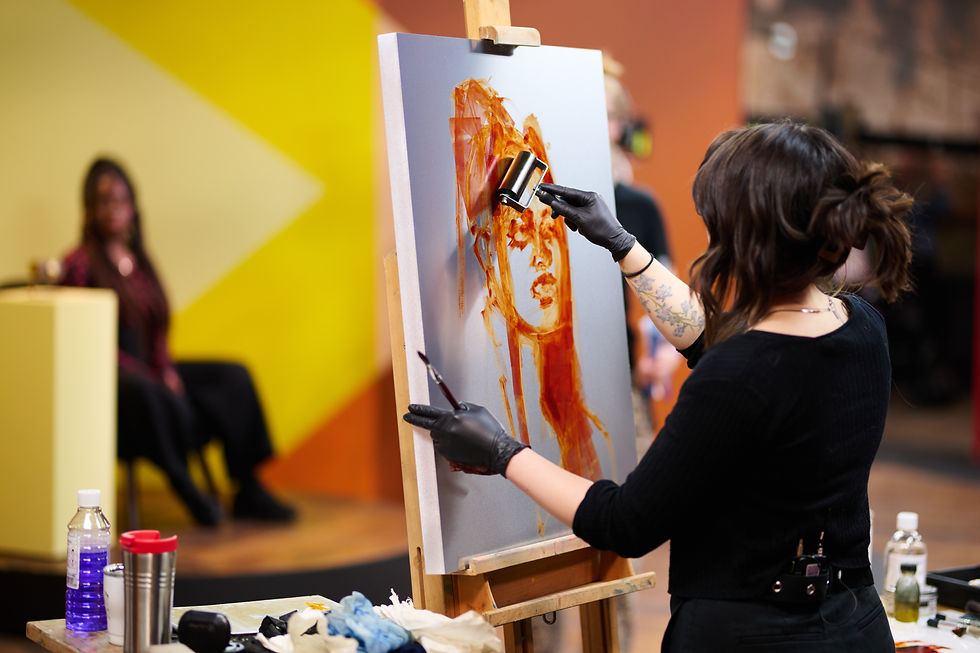
Painting: In Brian's portrait, I incorporated more 'dark field' monotype techniques into my painting, where I applied solid layers of ink to the plate and used scrim to wipe areas away. I envisioned the final monotype to have high contrast of light and dark areas, creating a sense of drama, which required rolling of ink, particularly in the background behind Brian.
During the painting stage of my process, I encountered several challenges:
Brian moved and chatted a lot during the sitting.
Like the heats and semis, I started my painting from life, wanting to capture more of Brian's essence. Brian was chatting and moving a lot, which I struggled with when trying to capture his likeness. Before the 2-hour mark, I ended up taking and working from a reference photo, but the challenge set me back.
Hot, hot, hot
The heat under the studio lights is hot. I noticed this in the previous rounds, and I was concerned that my ink was drying faster than normal, which would affect the printed image.
General exhaustion
For the whole of April, I poured everything I had into the competition and felt the exhaustion and strain in my body. As my work stems from emotion, I generally need to be well physically and mentally to increase the chances of making a 'successful' monotype. Between Brian moving, my exhaustion and having less time to paint my plate, I was fighting for Brian's likeness. I knew it wasn't perfect, but at some point, I had to shift my focus away from Brian to the image on the plate, working to balance out tones. Just over the 3-hour mark... I made the call to print. I couldn't rush this next step, so I went with it.
Printing: When it got to the printing stage, I suddenly found myself surrounded by cameras. The audience fell silent, and Tai and Stephen stood behind me watching as I took out my damp pack of paper, set up the press, laid out my board on the floor and prepared my gum strips.
The pressure was all-consuming. The calm ritual of printing was replaced with apprehension and tension as I recited the next steps in my head: plate, paper, tissue, press, print, reveal and tape. I had to re-register the etching press bed and also mark the mid-way point of my paper to align it with the plate. And then I printed... peeling back my paper away from the audience, I only caught my first glimpse of the monotype when I laid it flat on my board. I wasn't sure what to expect, but I instantly felt a sigh of relief - the plate printed ok, and there were no technical issues such as ink smearing or paper warping/ tearing.
Looking at my monotype, it was a bit lighter than I would have hoped. If I had used more pressure, I would have achieved a darker print, and my mark-making would appear less messy, but considering I never used this press before, I was happy and relieved with the outcome. I then taped my print to the board and spent my last 30 minutes adding finishing touches in watercolour and chalk - nothing extreme or drastic, but small things to enhance the monotype.
The Final Artwork and Afterthoughts
So here is the final piece. The likeness is not 100%, I felt like I captured an energy and essence of Brian, and successfully created a sense of drama and theatre. Although this was not my favourite portrait I've made during the competition, I was proud of the outcome and had hoped my commission was enough to help me through.
But at this point, I felt that the competition could still go either way. Lauren and Katie's paintings of Brian were all drastically different - Lauren wove a compelling narrative around her depiction of Brian, and Katie's skill in capturing likenesses and skin tones is beautiful. I loved how, as artists, we were all so different - I felt it was an interesting representation of contemporary portraiture, and each one of us deserved to win.

And without further ado... I am overjoyed and in shock to be announced the winner of Portrait Artist of the Year 2025. Thank you to all the judges, Stephen, Brian Cox, the Storyvault team and especially to my housemates and friends, who were my rock throughout this whole process.
So much blood, literal sweat and tears went into this competition. Despite taking a risk throughout the whole competition, adapting my practice and facing certain barriers, I feel immensely grateful and proud of how much I pushed myself. This whole experience is a bit of a fever dream. As I continue to process, I just wanted to say a massive thank you to everyone I encountered.
On one last side note, after the finals, I worked on my portrait of Brian, adding additional watercolour and pastel - mainly because I wanted to and had the desire to finish it. I also made a smaller monotype with hand glazing to prove to myself that I could capture Brian's likeness.
I will be releasing one last blog post on the making of Hannah Fry's portrait. This will most likely be released in several days, so stay tuned!




Comments