The Heats, Clara Amfo | Sky Portrait Artist of the Year 2025
Nearly 7 months after the filming, I am finally able to share my experience of the heats of PAOTY 2025. And before I get into the details of my heat portrait (and spoilers), I am excited to share that I've advanced to the semi-finals of the competition! I thought I'd break up the post into three sections: the preparation, my experience of the day, and my final portrait and afterthoughts.

The Preparation
As a monoprinter, I need access to an etching press to print my plates onto paper. The equipment is one of the biggest barriers that printmakers face for those wanting to participate in the show; printing presses are expensive, weigh a literal ton, and require a team of specialist movers to transport. Because of this, most printmakers (including myself) are members of print workshops where we share facilities - both my personal studio and my print workshop are conveniently based in South-East London. These spaces are fun, collaborative and a place where we geek out on techniques over cups of tea or coffee if you're a night owl like me.

For PAOTY, I knew I would not have access to a printing press, and I would have to alter my process for the heats. Over many years of painting my plates, especially during the Hesketh Hubbard life drawing sessions at the Mall Gallery, many people commented that the painted plates (sheets of aluminium) were a work of art in their own right. So, without access to a press, this was my pitch when applying to the competition - paint my plate like I would if I were making a monotype, and leave it as that, a painting on aluminium.
That said, straight from the bat, I knew this would be a risk and controversial; how would people accept the aluminium... especially when my self-portrait is on paper. In the end, I trialled and purchased an unsanded aluminium box panel from artistsurfaces.co.uk - their aluminium is museum-quality, resistant to corrosion/ oxidation, and I thought that the addition of a subframe would emphasise my final portrait as an artistic object, as opposed to a printing matrix. Typically, Artist Surfaces would finely sand the surface of the aluminium to allow oil paints to better adhere to the metal. To mimic the surface of printing plates and to achieve the full range of marks I'm used to making, I requested it to be left unsanded.

At this point, I knew that different ink colours react and look differently on metal than they do on paper; some pigments can oxidise on aluminium, appearing dirty. Others don't have a wide tonal range, and some look chalky and simply less appealing on metal. Lighting also plays a part in how it hits the aluminium and reflects the pigments and image to the viewer. In 2023, I was very fortunate to receive a grant from the Eaton Fund, which allowed me to purchase a selection of Charbonnel etching inks - this is the medium that I paint with. Similar to oil paints, it's solvent-based, but highly pigmented and archival. Etching ink is a lot stiffer than oils, which allows me to roll, wipe, and paint my portrait with expressive mark-making. Going into the heats, I had planned to paint with Prussian Blue; I knew the pigment reflected beautifully on the aluminium and was a 'safe' option. But, as you can see in my portrait of Clara Amfo, I deviated from the get-go...
Before attending my Heats, I decided that I wanted to go alone to Battersea Arts Centre without in-person support. If I asked, my housemates would have been there at the drop of a hat, but I didn't know what to expect on the day, and I wanted to focus entirely on me, my emotions and my process. On the show, I love watching friends and family cheer on the participants, regardless of whether they progressed or not. I felt anxious at the idea of not having my friends visible for the cameras to zoom in on; however, it felt symbolic that I was turning up for myself, following on from the subject of my self-portrait.
The Heats
On 2-3 hours of sleep, I turned up at Battersea Arts Centre. I was, of course, sleep deprived, a bundle of nerves, high on adrenaline and had the feelings of excitement in my fingertips. Post setting up, I went on a hunt for coffee, and we were treated to breakfast. Everyone from Storyvault was lovely and caring. Before each heat, all artists also had a chat with a psychiatrist (who specialised as a mental health advisor for high-profile television shows), and I was pleasantly surprised to find out that there were quiet breakout rooms, if we ever needed moments of silence throughout the day.
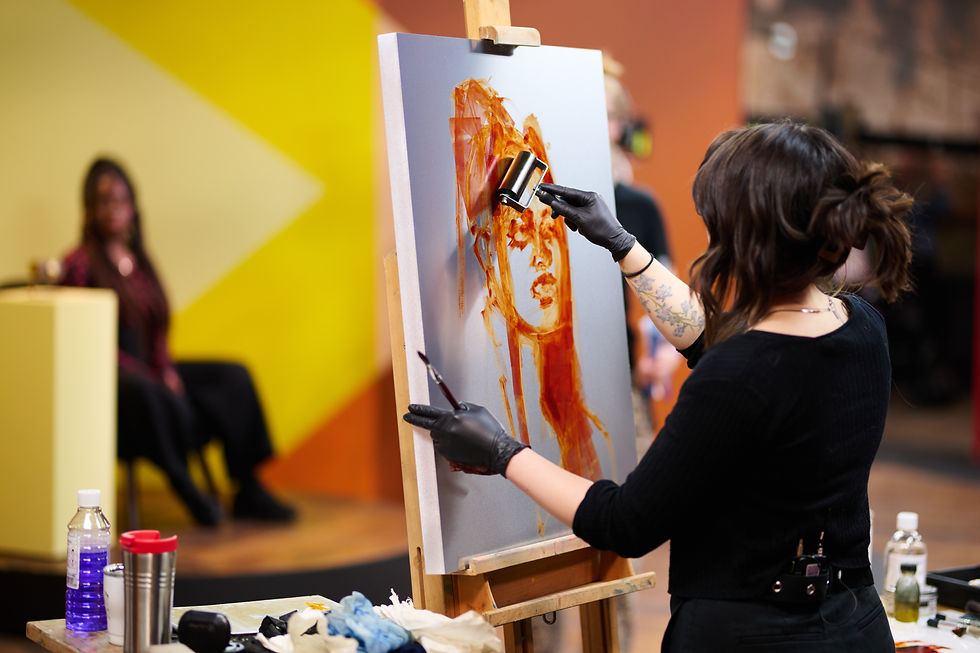
In my section, my celebrity sitter was revealed to be British radio broadcaster and television presenter, Clara Amfo! Admittedly, whilst I had heard of her, I didn't know much about Clara, so I had to try to form an emotional connection and reflect on how she presented herself to me and the wandering audience. Some characteristics that stood out were her strong presence and warmth, which complemented her edgy fashion and her braids. This 'warmth' really contrasted with the Prussian Blue I had originally intended to use... so once the heats began, I tested two warmer inks I had with me: a Burnt Sienna and a Burnt Umber. The Umber had yellow undertones, but the Sienna had a vibrant orange undertone, which was the most appropriate for Clara's skin tone, her backdrop, and the warmth of her personality. I could see that this ink also had a lot of tonal range and depth, ideal for painting on aluminium. A small note here is that the lightest areas on my portrait would be bare metal. Due to the chalky opacity of white inks, white 'highlights' would appear darker on the plate, whereas the bare metal reflects light, appearing lighter. I typically use cotton buds and small quantities of solvent to remove ink and bring areas back to bare metal.

In monoprinting terms, I use a combination of light and dark field techniques, where I apply and remove etching ink using a range of brushes, rollers, scrim, cotton buds etc. One thing I recall discussing with Tai was my use of solvent (I primarily use Zest-It, an orange-based, non-toxic solvent). When painting, the solvent can break down some of the oils in the ink, which allows the pigment to pool together, forming darker, more concentrated areas. I used this technique for Clara’s braids. I have to be careful with this, as too much solvent can cause marks to puddle and drips to form.
As an artist, I prefer working from life; I can get a better sense of dimension, subtle facial expressions and emotion. So for my heats, I painted Clara from life, without any photographic references. While professional life models try to remain perfectly still, what I overlooked before the day was that our sitters were faced with so much stimulation from the audience, camera crew, judges, and so on. And even with periodic breaks, it's really, really hard for anyone to avoid moving entirely. While Clara did move a little during her sitting, it wasn't a massive issue in this round, but it was a good thing to note for next time.
The Final Portrait and Afterthoughts

So here it is, my final portrait! I was happy with the final result; I felt that the colour, mark-making and likeness reflected Clara, and I am honoured that she selected my portrait to take home. I felt reassured that my risk of painting on aluminium paid off. The judges were positive with my alternate surface, and although different and perhaps controversial, I am pleased that I could draw a connection between this painting, my mark-making, and my monotypes on paper.
The only downside that I will say about painting on metal is that the camera crew had a tricky time battling with the light reflecting off the work (sorry guys!). In person, the way light hits the surface and draws attention to the mark-making and vibrancy of the inks encourages the viewer to walk around and interact with the piece, which I like a lot.
A massive congratulations to all artists in my heat, especially Jonathan and Jamie, who both brought their own unique and expressive painting style to the competition. I was blown away by the standard and what everyone accomplished in 4 hours - it's not easy, especially if you're used to painting in the comfort of your own studio, let alone being filmed with an audience, whilst being judged. Speaking of, I do feel incredibly grateful to the judges for their kind words and for seeing something in my work - so big thank you to Tai, Kathleen and Kate.

For the next round, I still planned to paint from life, but now I was considering taking a photograph to use as an additional reference. Capturing likeness is a key factor in this competition, so I thought it'd be wise to have an image to refer to, just in case the sitter was too far away or moved too much. There were some other things I wanted to work out, including testing more colours. Not wanting to play it safe, I intended to push myself further in the semis. So let's see what the next round has in store.
The semi-finals are scheduled to air on the 26th November at 8 pm GMT. You can watch the show on Sky Arts, Now TV and channel 36 on Freeview. If you want to stay up to date with my progress in the semi-finals and any other news, subscribe to my mailing list here.
Many thanks to Clara Amfo, the entire Storyvault crew, Tai Shan Schierenberg, Kate Bryan, Kathleen Soriano, the other artists and the audience for such a memorable day. Also to artistsurface.co.uk for speedily supplying my panels, and my housemates and friends who provided virtual support!


Comments